Differences in diplomatic messaging highlight gap over alliance priorities, as US seeks a greater South Korean role in countering China
The contrast between Seoul and Washington's approach to China's activities in the Yellow Sea is drawing attention to divergence in the allies' strategic priorities, raising questions about whether Beijing could become a source of friction in the South Korea-US alliance.
The contrast emerged following a trilateral foreign ministers' meeting in Atlanta on Friday (local time), with the US State Department explicitly raising concerns over what it described as China's "coercive behavior" in the Yellow Sea in a statement released after the talks. Seoul avoided directly naming Beijing in its own account of the discussions.
The differing statements underscore a broader strategic dilemma confronting the alliance: Washington increasingly views cooperation with Seoul and Tokyo as part of its wider effort to counter China's expanding influence across the Indo-Pacific region, while South Korea remains focused on deterring North Korea and preserving diplomatic channels with Pyongyang, an expert told The Korea Herald.
Park Won-gon, a professor of North Korean studies at Ewha Womans University, said the latest developments exposed a fundamental mismatch in what Washington and Seoul expect from their alliance and trilateral cooperation with Japan.
"For the US, trilateral cooperation is ultimately about countering China alongside its key Indo-Pacific allies, South Korea and Japan, although North Korea remains an important concern," Park told The Korea Herald on Monday.
"South Korea, by contrast, has little intention of actively joining efforts to contain China. Seoul's priority is to deter North Korean threats through trilateral cooperation while seeking to bring Pyongyang back to the negotiating table."
Park said that the differences go beyond diplomatic rhetoric and reflect competing national strategies that have increasingly complicated relations between Seoul and Washington.
"Washington expects South Korea to play a key role in countering China, not just addressing North Korea. But Seoul wants Washington to focus on deterring North Korea and facilitating dialogue with Pyongyang rather than containing China," he said.
"This fundamental divergence in national strategies lies at the root of many of the tensions currently affecting the South Korea-US alliance."
In a nutshell, Park explained that for the US, South Korea's strategic importance increasingly extends beyond its traditional role in deterring Pyongyang to supporting a wider network of regional security cooperation.
Seoul, however, faces a different set of strategic calculations, he said. China remains an important economic partner and a major player in diplomacy surrounding North Korea, even as Beijing's maritime activities present growing security concerns for South Korea.
The challenge for Seoul, therefore, is to determine how closely it is prepared to align itself with Washington's efforts without compromising its own diplomatic priorities.
Park said this divergence in national strategies should be understood as an underlying source of discord in the alliance, rather than an isolated disagreement over diplomatic language.
He noted that bilateral relations have already faced friction over a range of issues, including concerns in Washington about the treatment of American companies operating in South Korea.
Yet beneath those individual disputes, he argued, lies a more fundamental difference over the alliance's long-term strategic direction.
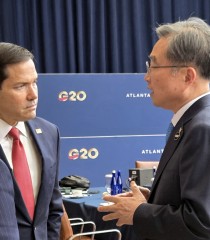
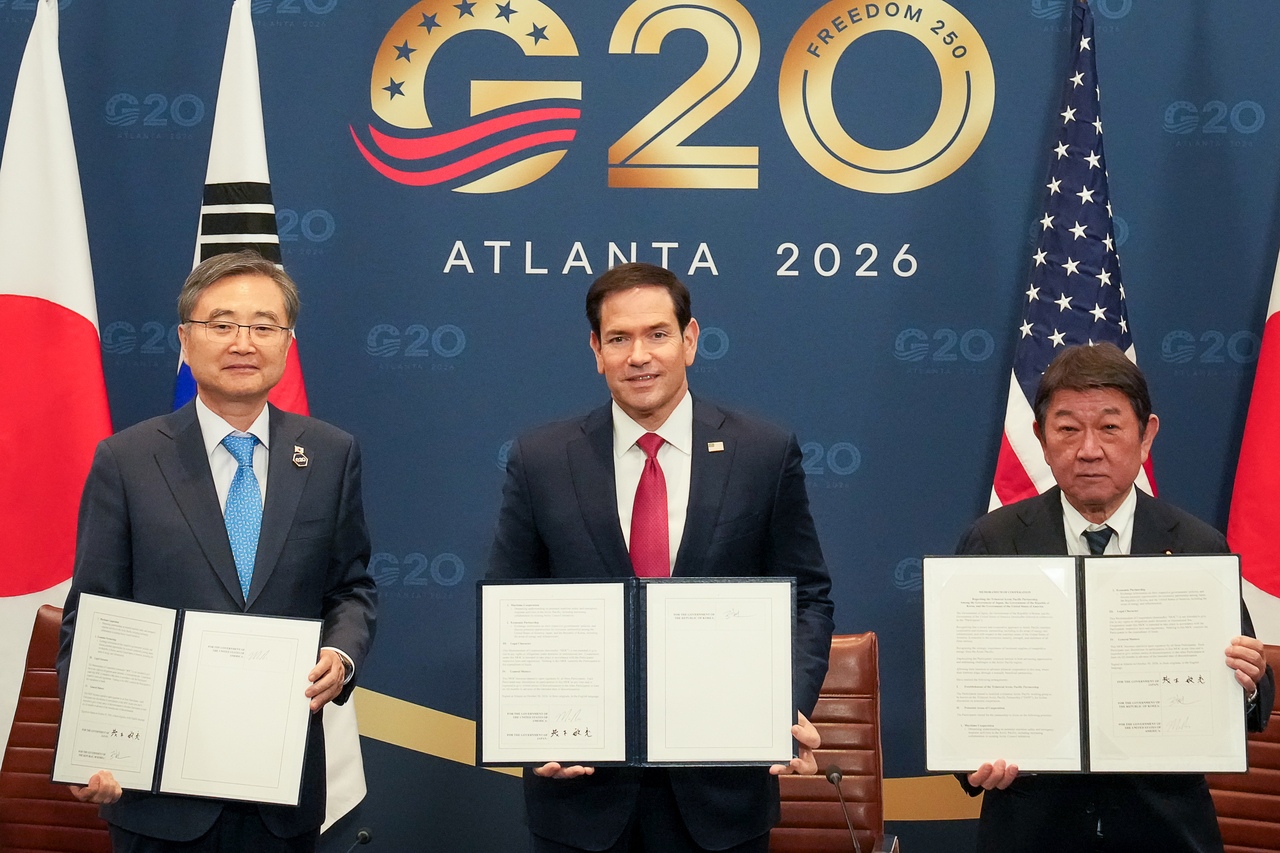
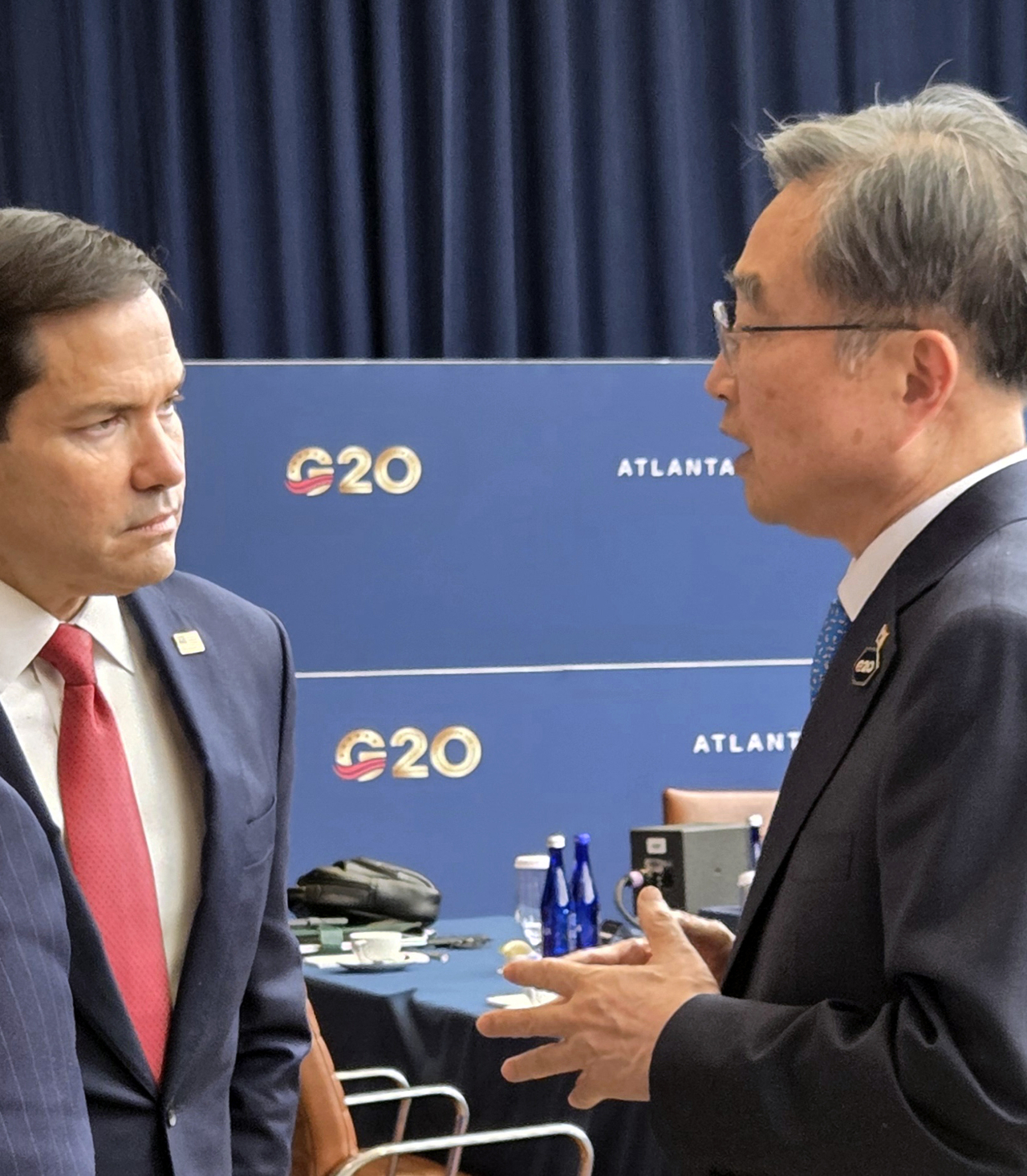
The latest diplomatic contrast was evident in the separate statements issued after South Korean Foreign Minister Cho Hyun, US Secretary of State Marco Rubio and Japanese Foreign Minister Toshimitsu Motegi met for approximately 20 minutes on the sidelines of the Group of 20 foreign ministers' meeting in Atlanta on Friday.
Unlike their previous gathering in New York on Sept. 21, which concluded with a joint statement, the three countries did not issue a joint communique this time, instead releasing separate accounts of their discussions.
The US State Department said Rubio had raised concerns over China's attempts to expand its control of the South China Sea, its coercive activities in the East China Sea and Yellow Sea, and growing cooperation between Beijing and Moscow that Washington believes undermines regional stability.
The explicit reference to the Yellow Sea was particularly notable, marking the first time this year that Washington had singled out China's activities in those waters in its account of a trilateral foreign ministers' meeting.
China has increasingly asserted its presence in the Yellow Sea, including through the installation of structures in the Provisional Measures Zone, where South Korea and China's exclusive economic zone claims overlap, and naval activities that have raised concerns in Seoul.
South Korea's Foreign Ministry, however, made no direct reference to China, the Yellow Sea or the Taiwan Strait in its statement.
Instead, Seoul said the three ministers had shared assessments of major regional and global developments, including attempts to unilaterally change the status quo, and agreed to strengthen communication and coordination.
The wording also revealed an important distinction in Washington's own account of the meeting. While the State Department said all three ministers emphasized the importance of maintaining peace and stability across the Taiwan Strait, it specifically attributed criticism of China's maritime activities to Rubio.
The omission of China from Seoul's statement does not necessarily establish that the allies disagreed during the meeting. Nevertheless, the differing emphasis in their public messaging illustrates the sensitivities surrounding South Korea's role in Washington's broader Indo-Pacific strategy.
The differences were also apparent in how the countries presented their approach to North Korea.
The US State Department and Japan's Foreign Ministry explicitly reaffirmed the three countries' commitment to the complete denuclearization of North Korea in accordance with UN Security Council resolutions.
Seoul's statement, meanwhile, placed greater emphasis on dialogue and diplomacy, saying the three countries had agreed to maintain a robust deterrence posture while continuing efforts to achieve peace, stability and denuclearization on the Korean Peninsula through diplomatic engagement.
Cho also stressed that South Korea would continue playing a "pacemaker" role in efforts to establish a peace regime on the Korean Peninsula and facilitate renewed dialogue between Washington and Pyongyang.
The contrast reflects a broader challenge as Washington pushes to modernize its alliances to address regional security threats beyond North Korea, including China's expanding military presence and influence.
An official at Seoul's Foreign Ministry, responding to questions over the differing diplomatic statements, reiterated Monday that Seoul has maintained communication and consultations with Beijing over the Yellow Sea.
"Our government has continued necessary communication and consultations with China based on its fundamental position that South Korea's legitimate and lawful maritime rights and interests must not be violated," the official said in a statement.
However, the official also cautioned against attaching excessive significance to differences in the statements issued by the three countries following the Friday meeting.
"Since press releases on the meeting's outcome are prepared around each side's main areas of interest among the various issues discussed, we do not believe it is necessary to read too much into every specific expression," the official said.
Despite the differences, the three countries reaffirmed their commitment to continued trilateral cooperation during the Atlanta meeting, signing a memorandum of cooperation on the Trilateral Arctic Pacific Partnership, aimed at expanding maritime and economic cooperation in the Pacific Arctic.
They also agreed to deepen cooperation on economic security, critical mineral supply chains, small modular nuclear reactors and emerging technologies.
mkjung@heraldcorp.com